

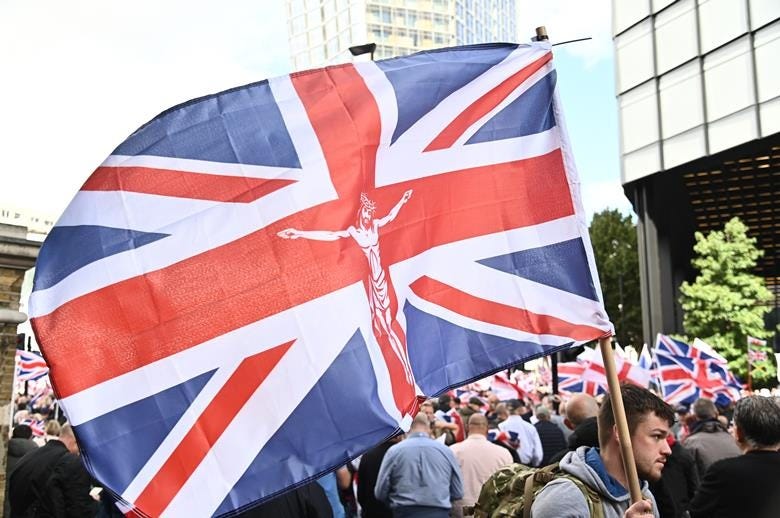
In recent months, across the country, members of the Better Story network have been quietly undertaking a new ministry at nationalist and anti-asylum protests. We call it ‘peace chaplaincy’ or ‘peace pastoring’, and it involves offering everyone present in these fractious spaces the chance to have their feelings listened to with love - from protestors, counter protestors and asylum seekers to passers by, charity volunteers, and police officers. In so doing, peace chaplains reduce tensions, open space for heart-softening dialogue, and identify opportunities for reconciliation.
We imagine some of you might have questions about this approach. Doesn’t compassionately engaging with anti-asylum protestors and asylum seekers create an equivalence between the oppressor and the oppressed? Doesn’t this legitimise views that ought to be challenged? Aren’t we called to truth as well as grace?
We hear you. Peace chaplaincy certainly isn’t a substitute for advocacy and activism - powerful voices need to be held to account for spreading hatred and division. But, as we will explore in the first section of this article, the majority of those who regularly turn up to anti-asylum protests are not the powerful people who are driving the vilification of asylum seekers. They are largely ordinary people who have experienced a high degree of their own suffering - from poverty to ill-health, grief to social isolation. We believe their harassment of minorities and asylum seekers is morally wrong and their anger grounded in thick entanglements of misinformation; because of this, as an organisation committed to resisting hate, it’s easy to cast these protestors as our ‘enemy’. And yet we cannot help but see their personal stories reflected in the lives of those whom Jesus loved and lived alongside. Peace chaplaincy has been a challenging chance to put Christ’s better story into action: to love our neighbour and our enemy.
With those (hopefully not too defensive!) caveats out of the way, we thought it would be interesting to give you a peace chaplain’s-eye view of our conversations with anti-asylum protestors, providing an insight into the ideas and feelings that fuel their attendance. The aim of this article is not to refute nationalist or anti-asylum arguments - we have done that elsewhere and will continue to do so - but simply to present them to you. For those who are serious about resisting hate and division, it is important to understand the motivations of people who regularly give up their time to protest. For this same reason, we will offer you steelman rather than strawman versions of the protestors’ arguments - instead of easily dismissed caricatures, expect the strongest, most generous interpretation of the statements we have heard.
Fair warning: what you will read is at times terrifying and at others tragic, and contains large amounts of explicit and implicit racism.
Who attends nationalist and anti-asylum protests?
Before examining the ideas expressed by anti-asylum protestors, it is worth briefly noting that a range of people gather under the Union Jacks, St George’s flags and - sadly - ‘Jesus is King’ banners to protest outside asylum hotels and refugee charity drop-ins. In our experience, they can be roughly organised into three groups:
1. ‘Auditors’
‘Auditors’ - sometimes called ‘migrant hunters’ - are mostly known for the invasive filming of asylum seekers in an attempt to show them doing something wrong and/or to intimidate them into leaving public spaces. This content is then uploaded onto social media where, for some of the more successful auditors, it can be monetised. There are often a handful of auditors in attendance at anti-asylum protests to a) film any asylum seekers in the vicinity, b) encourage protestors to engage in more divisive - and therefore more watchable - rhetoric and action, and c) try and provoke “lefties” (counter-protestors, charity volunteers) into saying or doing things on camera that undermine their support for asylum seekers. Auditors can be locals, but there is also a contingent of well-known auditors who tour protest sites across the country to generate content.
2. Committed far-right activists
Members of organised anti-migrant, anti-Islam, and ethnonationalist groups regularly attend protests across the country. These protestors are often the most extreme attendees - they are committed to far-right ideology, and have defined political objectives that are served by stoking extreme anger and even violence towards asylum seekers, counter-protestors, and refugee charity volunteers. Their commitment and motivation is attested to by the fact that many of this group - like the more successful auditors - travel significant distances to be present at protests around the UK.
3. Local protestors
Local residents whose attendance at protests is not motivated by growing a social media following or membership of a far-right organisation, but by a mix of deeply felt personal, local, and national concerns linked to asylum and immigration policy.
These groups are not static or totally distinct. Some local protestors may become auditors or members of far-right organisations over time, and auditors can be members of far-right groups. Nonetheless, local protestors comprise the majority at most protests, and as the most ‘authentic’ protestors they are often willing to talk to peace chaplains in an open and unguarded way. It is, therefore, the arguments of local protestors that we know best, and it is their voices we will present in the rest of this article.
What do people actually talk about?
Below we have collated the views of local protestors into the main conversational themes peace chaplains have encountered. The data is taken from a mix of vicars and lay-people across the country who are engaged in ‘peace pastoring’.
“Refugees are put up in four star hotels while British Army veterans are on the streets. I work 50 hours a week and pay my taxes and I can hardly afford to keep my head above water and no one is helping me. Why do they get everything for free and get all this support? It’s unfair!”
We frequently encounter protestors who believe that refugees and asylum seekers receive special treatment from the state and community organisations. The presence of asylum hotels is a significant contributor to this perception, alongside online misinformation about the amount of money and free goods asylum seekers are given. Furthermore, there is a view that asylum seekers are prioritised by institutions like churches, GP surgeries, pharmacies, schools, and housing providers.
This perception of special treatment is particularly prevalent in individuals who are carrying personal grievances about a lack of state and community provision. Veterans, for example, feel acutely aggrieved by the lack of support they have received relative to the support asylum seekers receive.
This perceived disparity in support fuels a deep sense of injustice in many protestors.
“I’m happy to help genuine refugees - look what happened with the Ukrainians, we were happy to welcome them because they were fleeing war. But these aren’t genuine refugees, they’re illegal migrants - why are they all young men? Why did they leave their wives and children at home if they’re actually refugees?”
Many protestors feel that people seeking asylum - especially those who arrive via small boats - are largely not genuine refugees. Some believe there are a minority of legitimate refugees among small boat arrivals, but express concern that the government is not doing enough to verify who is and who isn’t. They point to claims that small boat arrivals throw their documentation overboard, or to the minimal training received by Home Office employees tasked with determining the legitimacy of asylum applications.
Protestors often express a strong belief in the importance of legality in the migration system, categorising individuals arriving via small boats as “illegal” and so ipso facto an illegitimate presence in the country.
Some protestors are aware of the lack of safe and legal routes to claim asylum and how this might contribute to small boat arrivals. A minority are sympathetic to the idea of safe routes if these routes had a strict numerical cap and were limited to countries in perceived ‘genuine crisis’.
“It’s all men thrown together in this hotel, and they have sexual needs that can’t be met. They’re coming from cultures that see women as property and sexual objects. Having them here in this hotel is asking for trouble, and it’s putting our mothers, wives, and daughters at risk”
Protestors can be concerned about the safety of young women and girls in their communities. Some attend with placards reading “save our kids”. Many protestors will talk about rapes or sexual assaults in the local area that they believe have been committed by asylum seekers. Some female protestors have been victims of sexual abuse and are particularly worried for their own safety. These local and personal concerns are augmented by major national news stories, particularly the grooming gangs scandal.
The reality that many asylum seekers are young men also contributes to fears. Protestors sometimes say that they would be worried about any large group of young men moving into the area. However, there is particular concern around asylum seeking men linked to the view that they come from cultures that legitimate child sexual exploitation, denigrate women, and see white/western women as sexually promiscuous.
“I don’t even think they’re human”
The most distressing comments we hear at protests are from individuals who refuse to recognise the humanity of refugees and asylum seekers. While in our experience these views are in the minority, they are shocking, especially as they are often expressed in the language of ‘scientific racism’. We have heard one protestor claim that people from certain ethnic backgrounds are genetically incapable of integrating into British society. Another stated that asylum seekers from the Middle East were innately violent - referring to them as ‘beasts’. Claims that white British people have drastically higher IQs than asylum seekers are often made by protestors holding these dehumanising views.
In general, peace chaplains don’t directly rebuke peoples’ views - it can inflame rather than reduce tension, and impede our ability to create space for respectful dialogue and find opportunities to build bridges - but on the rare occasions that we hear this kind of language we make an exception. We believe the inherent, God-given, Imago Dei worth of every person is so foundational to our faith that we must challenge such overt dehumanisation directly.
“The bonds that used to connect people have broken down because of mass migration. It’s mostly Muslims coming and they create ghettos and don’t want to integrate with us because they don’t like our culture. It’s creating huge changes in the community - everything looks and sounds different than it did when I was growing up. More and more Muslims are coming, so it feels like we are being taken over”
People regularly vocalise a fear that their community - especially the centre of town and the highstreet - is being unrecognisably changed by migration. These views often focus on Muslim migration, with the presence of Halal butchers, mosques, and shops with Arabic or Perso-Arabic writing on the signs being a particular concern. Some protestors view this as part of a deliberate plan by Muslim organisations - most notably the Muslim Brotherhood - to overrun the UK and establish Sharia law.
Interestingly, concerns about the ‘Islamisation’ of Britain also comes up in communities that have only a small Muslim population. London is often talked about as no longer a British city, but rather an unrecognisable Islamist dystopia (Londonistan) - the fear is that if migration continues, this condition will spread across the UK.
A few protestors have expressed a belief in the ‘Great Replacement’, a conspiracy theory which posits that subversive forces are deliberately trying to replace white Europeans with non-white/Muslim migrants.
“I feel helpless and hopeless and out of control. I’ve come to the march because it’s something I can do.”
One of our commonly used phrases at Better Story is “the grief beneath the belief”. When engaged in conversation, protestors usually start by presenting some version of the grievances you have just read. But there is almost always deep grief and a sense of unmet need lying just beneath the surface. Compassionate conversation serves to bring these underlying feelings into the light.
In our peace chaplaincy, we hear people talk about mental health struggles; housing problems; a loss of community; unemployment; physical health issues; and a wide array of institutional failures that have directly impacted their lives. Adverse childhood experiences - from sexual abuse to abandonment - and experience of the care system are common. There is frequently an underlying sentiment that as individuals and a community they have been forgotten and abandoned by Westminster and sneered at by middle-class people who are out of touch with how difficult life is for ordinary people.
Protesting is explicitly linked to a desire to cast off the invisibility and insignificance imposed upon them by society.
Conclusion
In our experience, personal suffering is a significant factor in the sentiment at protests outside asylum hotels.
It is fertile ground for discontent when combined with safety concerns, human resistance to change, and the perception that refugees and asylum seekers receive special treatment. Far-right parties and politicians hijack these feelings and stoke anger, fear, and racism by continuously scapegoating asylum seekers, migrants, and minorities for their own ideological ends. Foreign powers leverage these feelings to wage information warfare and weaken our democracy. Social media algorithms maintain the sense of injustice and outrage by creating echo chambers of misinformation. In this toxic milieu, we should expect more people to become attracted to nationalist and anti-asylum ideas.
Thank you for sharing this 👍
I really appreciate your work of trying to bring forward the steelman arguments so we can have real conversations 👍
Thanks for this insight and thanks that your ministry is compassionate and empathetic to people's suffering.